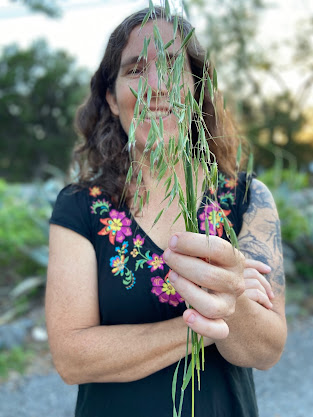
* About ten years ago, I wrote a book highlighting the most common and abundant wild edible plants of Texas and then placed it on the backburner as I focused on other projects. It hasn't been published yet, but I do publish pieces of it here and there on my blog. I've recently considered packaging it for publication and might get around to it soon. So, as you read through my blog, you may note that some of the writing is more formal and sounds like a guidebook. As I move this project back into the forefront, I want to re-focus the writing on my own personal experiences with these plants and the land, water, and people supporting and nurturing them. Over the last ten years, my love for the Texas Hill Country has deepened, and my relationship with the plants has expanded. Living with the land, foraging, gardening, hiking, swimming, and growing older and wiser has inspired me to reconsider everything I wrote ten years ago. I am pleased to see that the information is still relevant and accurate, but there is a need for more conservation and preservation language. I've seen the Texas Hill Country explode with extensive, unchecked development, presenting a more urgent need for conservation. As foragers and herbalists, we are always concerned about protecting individual plants or patches of good food and medicine. However, the need to protect entire parcels of land and waterways is imperative. I hope to expand my book to include landscape-scale considerations so stay tuned and enjoy your adventures!
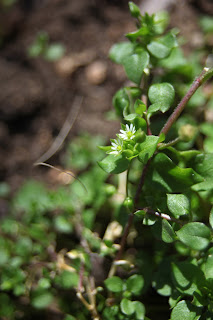
Stellaria media
Eat
the leaves, stems and flowers raw in salads, sandwiches, or as a garnish. Watch for this potherb to emerge very soon here in the Texas Hill Country!
Named for the farmyard animal that
adores it, chickweed is a delicacy in more circles than poultry. A perfect
substitute for lettuce with its mild, sweet taste, chickweed is also rich in
iron, zinc and potassium.
Chickweed is delicate and
unassuming as it creeps and flows along the ground. Its thin, succulent stems
radiate out of a basal center and flop over, causing the plant to look like a
matt or tightly woven patch on the ground. A line of tiny, white hairs along
the stem help distinguish chickweed from other similar, though non-edible
plants such as scarlet pimpernel. The
leave of this annual herb are small, succulent, and have smooth, though
ruffled-looking edges and come to a distinct point at the tip.
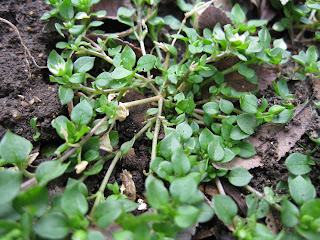
Chickweed can be harvested by
snapping off the tips of the plants or snipping with scissors or clippers. If the
plant has spread far and wide over the soil surface, gather all the flowing
stems into your fist and snip the whole bunch off. If some leaves are left on
the plant, the chickweed will continue to grow and provide more delicious
greens for your salads or stir-fries. Allow it to flower and spread seed for future seasons. Chickweed, like most wild greens, will
benefit from hydro-cooling before storing. Chickweed will keep in a plastic bag
or vegetable crisper for a day or two.